
Portfolio
I am not one to be boxed in as a scientist. I specialise in marine robotics but do not necessarily stay strictly close to home base. I would like to explore climate engineering through water. Or quantum entanglement in marine science.

Hurricanes draw their energy from the ocean, yet the subsurface conditions beneath these storms remain poorly understood due to the extreme difficulty of collecting in situ measurements. Traditional ship based observation is impossible during active storms, leaving critical gaps in our knowledge of heat exchange, mixed layer deepening, and current dynamics that drive storm intensification. Autonomous underwater vehicles offer a unique capability to occupy these hostile environments, providing sustained observations of temperature, salinity, and velocity profiles throughout the water column before, during, and after storm passage. These measurements are essential for improving coupled atmosphere ocean models that forecast hurricane intensity and track. Understanding how storms modify the ocean and how the ocean in turn fuels or weakens storms is one of the most pressing challenges in oceanography and climate science. My research contributes to this effort by developing vehicles and models capable of operating in high sea states and capturing the rapid changes that occur beneath the surface during extreme weather events.
Computational fluid dynamics (CFD) provides high fidelity insights into the complex forces and moments acting on robotic systems, particularly in fluid environments where traditional analytical models fall short. By extracting hydrodynamic derivatives from virtual experiments such as the Virtual Planar Motion Mechanism (VPMM), we can construct physics informed dynamical models that accurately capture vehicle behaviour across a wide range of operating conditions. I have successfully applied this approach to autonomous underwater vehicles, demonstrating improved stability prediction through novel design indices (Miller et. al, 2021) and validating CFD informed models against both numerical simulations and field trials (Miller et al. 2023). These methods bridge the gap between computationally expensive simulations and real time control requirements, enabling autonomous systems to predict their own motion with greater accuracy.
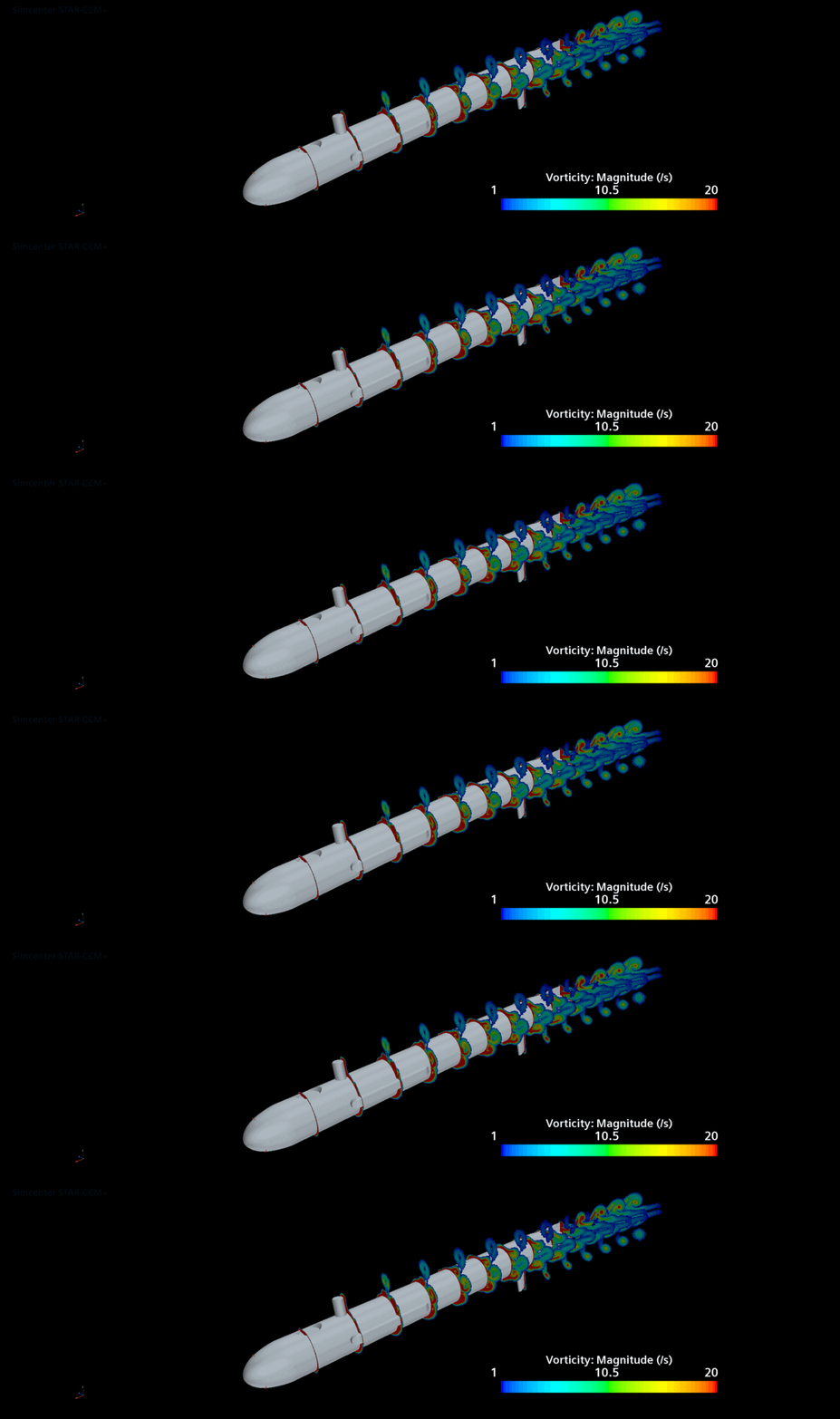

The methodology of using high fidelity simulations to inform reduced order dynamical models extends well beyond underwater vehicles. Computational fluid dynamics and finite element analysis can characterise the complex physics of robotic systems, extracting parameters that would otherwise require extensive physical experimentation. For aerial vehicles, virtual wind tunnel testing yields aerodynamic stability derivatives much like the VPMM approach. In legged and soft robotics, finite element simulations capture ground reaction forces, joint compliance, and continuum deformation, which can then be reduced to computationally tractable models suitable for real time control. The same principles apply to manipulators operating at high speeds or in collaborative settings, where link flexibility and joint dynamics become critical. Across all these domains, the workflow remains consistent: conduct high fidelity simulations, extract governing parameters, construct simplified models, and validate against experiments or higher fidelity benchmarks. This simulation informed approach accelerates design iteration, reduces prototyping costs, and ultimately enables more capable autonomous systems.
Autonomous systems require the seamless integration of navigation, guidance, and control to operate effectively in complex and uncertain environments. Navigation provides the vehicle with an accurate estimate of its state, fusing data from sensors such as inertial measurement units, acoustic positioning systems, and vision based methods. Guidance translates mission objectives into desired trajectories, accounting for environmental disturbances, energy constraints, and obstacle avoidance. Control then executes these trajectories by commanding actuators to track the desired motion while rejecting disturbances and compensating for model uncertainties. The performance of each layer depends critically on the fidelity of the underlying dynamical model, which is why simulation informed approaches are so valuable. Accurate models enable tighter control, more efficient path planning, and improved state estimation, all of which contribute to extended mission endurance and greater operational reliability. My work focuses on closing this loop by developing physics based models that enhance autonomy across the full navigation, guidance, and control stack.
(Image courtesy: RTsys.)
